Showing posts with label Anime. Show all posts

Thursday, July 7, 2011

Japan's Walt Disney?

Hayao Miyazaki is one of Japan's greatest animation directors. The entertaining plots, compelling characters, and breathtaking animation in his films, such as Howl's Moving Castle and Spirited Away, have earned him international renown from critics as well as public recognition within Japan. The Walt Disney Company's commitment to introduce the films to the rest of the world will let more people appreciate the high-quality works he has given the movie-going public.


Documentary about Studio Ghibli and the legendary anime director Miyazaki.  Includes interviews with a variety of animators, directors, artists etc. in the field of anime, as well as Miyazaki himself.


Saturday, April 16, 2011

Parabol (Ep01)

par·a·ble
Spelled Pronunciation [par-uh-buhl]
–noun
1. a short allegorical story designed to illustrate or teach some truth, religious principle, or moral lesson.
2. a statement or comment that conveys a meaning indirectly by the use of comparison, analogy, or the like.

Etymology:
Middle English, from Anglo-French, from Late Latin parabola, from Greek parabole comparison, from paraballein to compare, from para- + ballein to throw — more at devil
Date:
14th century

A parable is a brief, succinct story, in prose or verse, that illustrates a moral or religious lesson. It differs from a fable in that fables use animals, plants, inanimate objects, and forces of nature as characters, while parables generally feature human characters.

Parabol'.

Parabol takes place in a grungy apocalyptic world where fossil fuels have been all but exhausted and are only available to the military and the corporate elite. The lower cities, known as the “Poverty Zones”, are in a state of squalor. The world government and it’s economy is run by a global corporation known as “GovCo“.


Parabol is an original CGI mini-series created by "figment'68" and released by "AmerikAnime". All rights reserved. You can see more of his work by visiting his YouTube channel. 
  

Saturday, November 20, 2010

Soul Eater (Ep 02)

The three main meisters of Soul Eater (from le...Image via Wikipedia

I know, I know, "Funimation" isn't exactly an alternative to the mainstream, as a matter of fact it has become THE mainstream producer of cookie-cutter Anime here in the states. So what? I was turned onto "Soul Eater" by a dear friend and I'm breaking the rules.


Soul Eater is an anime that centers around meisters and their weapons and their mission to collect 99 evil souls and 1 witch soul. Upon doing that the meister's weapons will become a Deathscythe, which is the highest title for a weapon. Maka, Soul Eater, Black Star, Tsubaki, Death the Kid, and Patty and Liz Thompson are the characters Soul Eater revolves around. Besides taking the time to gather souls these students of Shibusen defend Death City from some of the most powerful of creatures while still attending school and trying to become stronger.

Sunday, November 14, 2010

FREEWARE - Mike Kaczmarek

Visually stunning and action packed, Freeware is a 3-D, CG-animated thrill ride through a futuristic world.


This sci-fi short follows three cyborgs on a daring race to rescue Maia, an assistant at a powerful IT company, from the grips of its evil CEO. All animation was created using Alias/Wavefronts Maya.

Saturday, November 13, 2010

Anime-zing!

All of the latest Anime news and events.


Brought to you by clipsyndicate.com.

Soul Eater (ep. 01)

Death Weapon Meister Academy.Image via Wikipedia
I know, I know, "Funimation" isn't exactly an alternative to the mainstream, as a matter of fact it has become THE mainstream producer of cookie-cutter Anime here in the states. So what? I was turned onto "Soul Eater" by a dear friend and I'm breaking the rules.


This one goes out to you Missy...


Video provided by souleater-episodes.com

Saturday Morning Cartoons!

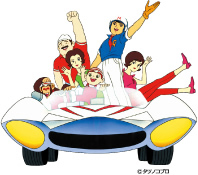
From left to right: Chim-Chim, Pops, Mom, Spri...Image via Wikipedia
This week on Saturday Morning Cartoons I would like to share one of my all time childhood favorite cartoons known here in the States as Speed Racer. Way before Speed Racer became a blockbuster movie, it was a simple 60s-style Japanese cartoon. The original Speed Racer was a TV anime series called Mach GoGoGo, aired on Fuji TV—one of Japan's major television networks—in 1967 and 1968. Like many other sources of entertainment in Japan at the time, Go's determination and the superior technology of Mach 5 were symbolic of the country's rapid post-war recovery and the determination that drove it. All that being said, the show was nothing less than monumental to me as a child. Up until Speed Racer came along we television children had to make due with the simple antics of "Looney Tunes" and "Hanna Barbara". Then Speed came screeching onto the t.v. screen and everything changed. Speed Racer was my initiation into the world of Japanimation, and would continue to influence my artistic style for most of my life. Oh there have been other, some might even say "better", Japanimation and Anime out there but for me, Speed Racer was the first. Let me take you back in time and show you a glimpse of the original.


Speed Racer is an English adaptation name of the Japanese manga and anime, Mach Go Go Go which centered on automobile racing. From 1967 to 1968 it ran as a television series in the United States, with 52 episodes. Selected chapters of the manga were released by NOW Comics in the 1990s under the title Speed Racer Classics, later released by the DC Comics division, Wildstorm Productions under the title Speed Racer: The Original Manga. In 2008, under the name of its Americanized title, Speed Racer, Mach GoGoGo, in its entirety, was re-published in the United States by Digital Manga Publishing and was released as a box set, used to commemorate the franchise's 40th anniversary and also served as a tie-in to coincide with the 2008 film. It was published under the title Speed Racer: Mach Go Go Go as part of the company's DMP Platinum imprint. The actual television series itself is an early example of an anime becoming a successful franchise in the United States, which spawned multiple spinoff versions, in both print and broadcast media.